By Onur Romano, Human Rights Chair and Director of Assistance for Apostates, Centre for Inquiry Canada
The machine in a porcelain workshop that presses clay into plates does not know who is standing at it. It does not know that the woman feeding it was a professional in Tehran, that she and her husband had fled Iran because they made a documentary the regime could not tolerate, or that she was in this loud, dusty room in Kütahya, Türkiye, because it was the only work an asylum seeker without a permit could get. It only knows that a finger was where a finger should not be.
This is a story about Maryam Morovvati, who goes by Anahita. It is 1 of 6 pieces Centre for Inquiry Canada is publishing this year about her and her husband, Ramin Saberi Jafari, the first lives saved by our Assistance for Apostates program. Each piece stands on its own. This one is about her body, and what it was worth to the country that was supposed to protect her.
How she came to be at that machine
Ramin and Anahita left Iran in 2017 to film interviews for a documentary critical of the Islamic Republic. While they were in Türkiye, their colleague in Iran was arrested and the Revolutionary Guard raided their home and seized everything connected to the film. Going back meant prison. They registered with UNHCR in Ankara and were sent to Kütahya.
Türkiye’s system, as Ramin describes it, has a one-sided formula: “it accepts the refugee; the refugee is then responsible for surviving.” No financial assistance. No housing. And, in practice, no legal work. An employer must apply for a permit and pay insurance to hire an asylum seeker, and almost none do. Why pay a legal wage to someone who cannot go to the police? So Ramin and Anahita, a filmmaker and a computer specialist, worked for 9 years in what Ramin calls “rough and unsafe jobs” in workshops, off the books, for wages that “barely” covered survival. No contract. No health insurance. No accident coverage.
They were also treated as fools. “There were many occasions,” Ramin writes, “when Turkish employers or coworkers would explain to us how to make tea, how a boat or car works, or even how to peel an orange.” Two professionals from a capital of millions, taught to peel fruit.
The car
One day the machine severed Anahita’s finger.
The owner of the workshop saw what had happened. He put them in his car and drove them, in Ramin’s words, “as far as the street beside the hospital.” He did not go in. Before they got out, he told them that if they said the accident had happened in his workshop, both of them would be fired.
They ran to the emergency department in their dusty, filthy work clothes, Anahita carrying the severed part of her finger in her other hand, blood pouring from the wound. The doctors, Ramin writes, looked at them “as though we had just survived an earthquake.” They asked whether the accident had happened at work. They asked whether the couple wanted to report anyone.
They said no. They said they had wandered into an abandoned building and the floor had given way.
“I imagine nobody at the hospital believed the story we told,” Ramin writes. “And they were right not to believe us. Perhaps we were also right to lie. Because if we had told the truth, there was a very real possibility that by the end of that week we would not have had enough money to buy food.”
Read that once more. A woman holding part of her own hand, lying to the people trying to help her, so that she and her husband could eat that week.
What else the body paid
The doctors saved the finger. They reattached it, and over the following months it healed, months in which Anahita could not work, in a household that could not afford to lose a wage, and in which her depression deepened. The finger was the visible price. There were others. When Ramin developed a serious case of bronchitis, he was confined to their home for nearly 10 months because they could not afford the treatment; a family doctor’s free consultations were all they had, and consultations do not cure bronchitis. Anahita went to the workshop alone. Twice, Ramin was fired the moment an employer understood he was not a believer, which meant that in the country that had accepted them as refugees from religious persecution, being an atheist still cost them the food on the table.
And there was the damage you cannot photograph. “The hardships in Turkey left Anahita with severe depression,” Ramin writes, and “years of medication” that “became one of the souvenirs those terrible circumstances left behind for her.” He does not spare himself either: “And for me, there is a deep wound. One that may never fully heal.”
They were not invisible. They wrote to organizations across Europe, the UK and Australia. In Ramin’s words, “almost no one helped us.” The organizations that did eventually help them were the ones built for people like them: the Atheist Refugee Assistance Program (ARAP) in Türkiye, which arranged counselling for both of them during their last years there, and Secular Rescue at the Center for Inquiry, whose letter to UNHCR described a couple living “under dire conditions,” facing “widespread discrimination in employment and medical care,” and “forced into exploitative, underpaid labor in order to survive.” In July 2026, UNHCR resettled them in Canada.
Where she is now
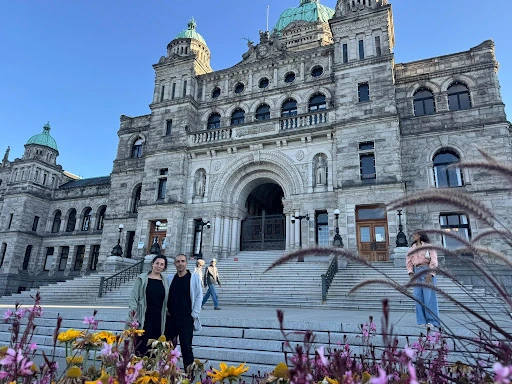
Anahita has 10 fingers. The surgeons in Kütahya stitched the severed one back, and it healed. She lives in Vancouver. She has, in Ramin’s words, “secure residency, the right to work, health insurance, and the basic conditions necessary to live in peace. A place where we do not have to lie in a hospital with a severed finger simply because we need to make sure there is food on the table at the end of the week.”
That sentence is the whole story. Not the finger. The lie. What kind of system makes a woman lie about her own severed finger? One in which her body is worth less than her employer’s convenience because she has no status, no permit and no one to call. That system still exists. Someone is standing at a machine in it this morning.
A word about who is asking
I direct Assistance for Apostates at CFIC and I founded ARAP in 2020 through the Ateizm Derneği International Foundation in British Columbia. I came to this work the hard way: I am an atheist refugee myself, and in 2014 I founded Ateizm Derneği in Türkiye, the first and only legally recognized atheist human rights organization in the Muslim world. Today I also direct the Atheist Support Network at Atheist Alliance International and work as a case manager for Secular Rescue at the Center for Inquiry. I have read hundreds of files like Anahita’s. I have not got used to them, and I do not intend to.
ARAP provides what Anahita needed and did not have for 7 years: a safehouse and a women’s shelter, both sponsored single-handedly by the David P. Silverman Charitable Fund; help finding legal work and landlords who will rent to a refugee; pro bono lawyers; official letters to UNHCR; and counselling. CFIC is now a partner in that alliance, alongside Minnesota Atheists, and every A4A application is vetted by Secular Rescue before we act. The next woman at the next machine can have a phone number to call. Whether she does is up to you.
How to help
Assistance for Apostates: The First Lives Saved, Centre for Inquiry Canada’s Assistance for Apostates fundraiser, runs until June 30, 2027 with a goal of $12,000. Every dollar goes to 3 things. $4,000: support of ARAP’s activities in Türkiye, which keeps its case managers, safehouse and legal aid running in Türkiye. Part goes directly to Ramin and Anahita as they rebuild their lives in Canada from nothing. The remainder goes to the next cases Assistance for Apostates and ARAP are working to relocate to Canada in 2027, people who are, right now, exactly where Ramin and Anahita were 2 years ago. Centre for Inquiry Canada issues tax receipts for all donations.
Give today: https://www.canadahelps.org/en/dn/149797