This month we have a recap, another personal note / digression and the new material.
Recap
Last time I shared a brief partial review of a 20-year-old book in the philosophy of science. I’ve received as yet no commentary or questions on this. I also did not get any reactions to celebrating Mole Day. As I write this, this holiday has yet to happen still, so perhaps I should be patient.
Digression
November marks my 50th birthday. (Yikes!) Have a happy-my-birthday everyone. If you want to give me a present, support in whatever way you can (even if just “morally”) public education – I have benefited greatly from this, including at second and third hand. If you want to give another one, write back to me with a suggestion for the next column. 😊
What’s New
This month’s column is about the so-called Pinocchio Paradox. This is a fun little variation on the classic liar (and likely has some of the same challenges to resolve) and was new to me until quite recently. I’ll state one version of the paradox, analyze it and riff on a few of the themes and ideas that come up. As usual, your mission, dear reader, is to see what you think and my job is merely provocation – of a good kind, I hope.
Many of us have read or seen classic versions of the fairy tale, Pinocchio or similar. I remember as a child seeing the Disney version though I have no clear sense when or why. The story revolves around the adventures of a wooden doll, ventriloquist’s dummy or mannikin come to life through magic, who also has the unusual trait of having his nose grow whenever he tells a falsehood. He also is famous for wanting to be “a real boy”. For purposes of the present column there are only two important aspects of this fable. One is that the creature in question is the result of magic; the other is the nose bit.
So, with that in mind, consider the sentence: “My nose will grow if I state this.”
An obvious falsehood for myself and I trust all of my readers. However, then consider Pinocchio saying it. If he’s telling the truth, then “My nose will grow if I state this.” is true, and hence his nose will grow. But his nose should only grow if he’s telling a falsehood, so woops, that’s not right. Similarly, if he’s telling a falsehood, his nose should grow, because he’s telling a falsehood. But then his nose did grow, so that’s not right either.
As the reader can see, this looks like a version of the liar paradox. (“I am lying.”)
However, it is a paradox that seems to have consequences beyond the truth or falsehood of statements – namely, what happens in the world. Here are several possible ways out of this problem.
First is to deny that Pinocchio as described can exist. Maybe the situation is like the barber paradox – where the village that supposedly has a barber that shaves all and only those who don’t shave themselves just cannot exist. However, how would one experience trying to construct the doll? There are philosophers who think one can experience a logical contradiction in various ways; I’m sort of dubious. On the other hand, that there’s a “superstition” against them (Wittgenstein and Priest, for example) seems also wrong. (Priest thinks some of them are true; Wittgenstein thinks they are just epistemic “no-operations”.)
Second, one could deny that telling a falsehood to make a nose grow is implausible for other reasons – even with magic. Why? It would turn Pinocchio into an oracle – just get him to utter anything. Even if he doesn’t have access to that part of himself until the nose grows, he then becomes a way to determine the truth of any statement – as written.
On the other hand, there’s another way to describe Pinocchio’s unusual nose that is sometimes heard: his nose grows when he lies. In which case, there’s seemingly no paradox at first glance. Delving into this prompts a discussion of what lying is. At first blush, a lie is a knowing statement of a falsehood. It doesn’t have to be for gain, but one has to be (in some sense) caring that one has uttered one – otherwise one is a bullshitter (sensu Frankfurt), rather than a liar. This can be so even for good motives (unless one is a Kantian or perhaps even just Kant) – the so-called “white lies” are in this category.
But then there’s a further problem. Pinocchio or someone else can run this analysis (telling him if he can’t do it himself) and then because he knows he’s stating something true or false, he cannot claim innocence (like he might have earlier) and we seem to be back where we started.
Changing tack, slightly. When I first encountered this, I thought of Raymond Smullyan’s little book (which I want to eventually chase down at the used book sellers) that I read as an undergraduate – Forever Undecided: A Puzzle Guide to Goedel. In it we read discussions of sentences like: “The reader of this column cannot believe this sentence even though he knows it to be true.” I couldn’t figure out how to make this sort of pseudo-epistemic logic get any purchase on the Pinocchio Paradox – but maybe someone else can see what I think I saw and run with it better.
Another possibility is to use a third truth value – but that might subject Pinocchio to the revenge liar problem. Nevertheless, I invite the reader to consider the difference between Pinocchio’s nose growing when he states something that is not true, vs. stating something that is false. What if it is the latter? Then “My nose will grow.” could be taken as neither true nor false, so he’s off the hook and the nose stays as is.
There’s another possibility family – where I will leave the column for today – which is that one has to use one of the many techniques (all of which are much too complicated) to solve the liar paradox and apply it here directly.
¹ If you think I’m mistaken about the nose, precisely, hold that thought! You’re on to part of the puzzle.
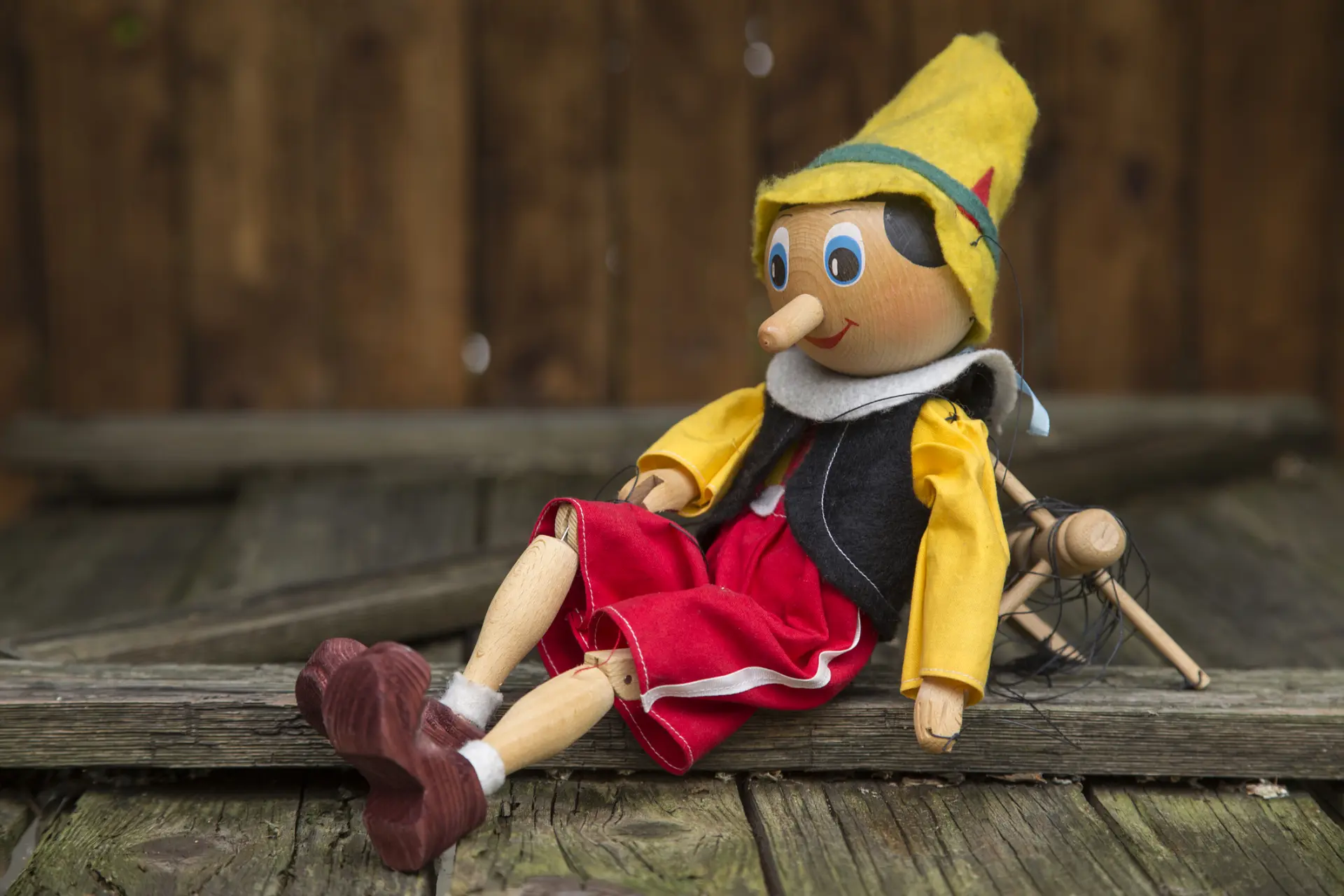
Pinocchio Old Wooden Marionette Toy, photo by Boskoboca, via Dreamstime