
Leslie Rosenblood
Religion on census needs a rework, group says
Humanist organization argues question’s framing leads to an overestimation of the number of religious Canadians.
JOHN LONGHURST
DID you get the long form of the census? If you did, then you are among the 25 percent of Canadians who had a chance to tell the government about your religious identity.
The federal government has been collecting information about religion in Canada since 1871; it’s one of the oldest efforts to track religion in the world.
Since that time, the religious landscape in Canada has changed a lot. Up until the 1960s, the country was mainly Christian, with small numbers of Jewish, Muslim, Hindu, Sikh and Buddhist Canadians.
The 2026 census lists over 200 religious groups, just over half of them Protestant and Catholic. The rest are from a wide variety of other religious traditions, including six streams of Buddhism, 10 different Jewish groups, seven kinds of Islam and five different forms of Indigenous spirituality. People can also choose from Wiccan, Satanist, Rastafarian and New Age groups, among others.
Until this year, the census included a question about religion every 10 years.
But it was included in the 2026 census for the first time. Why the change? One reason is the rapid growth of minority religions. The number of Canadians who are Muslim, Sikh and Hindu was six per cent of the population in 2011; by the 2021 census, the last time it was measured, it was over nine per cent. That figure is expected to be much higher now due to immigration.
Another reason is the dramatic rise in the number of Canadians who say they have no religion on the census — the so-called “nones.” They made up more than 29 percent of Canadians in 2011 and more than 34 percent 10 years later in 2021. Scholars who study religion in Canada think that the number could be as high as 40 percent now.
That change will be of interest to religious leaders and to scholars who study religion. But who else cares if increasing numbers of Canadians are leaving religion?
One sector that cares is the charitable sector. Research in Canada consistently shows that the more religious someone is, the more they volunteer and give to charity. Any decrease in the number of people who say they are religious will impact groups that serve the most vulnerable in Canada and around the world — a downturn in donations will, in turn, affect governments that are increasingly relying on charities to provide services to people in need.
While the religion question has been around for a long time, and provides a snapshot about changes to the religious landscape over the decades, not everyone is happy with the way it is framed. That includes the Centre for Inquiry, one of Canada’s leading humanist organizations.
The way the long form census poses the question is like this:
“What is this person’s religion? Indicate a specific denomination or religion, even if this person is not currently a practising member of that group.”
The centre thinks the second half of the question skews the answer, resulting in an overestimation of how many people in Canada are actually religious.
If you aren’t actually practising a religion, the centre says — if you aren’t attending a place of worship, for example, or donating to help others because of your faith or following religious tenets in other practical ways — can you really say you are religious?
That’s the view of Leslie Rosenblood, the secular chair for the centre. If someone isn’t actually practising a religion, “they should say they have no religion” when answering that question, he said. Otherwise, they are just choosing the religion they were raised in, instead of representing their current status as a non-religious person.
Because of the way the question is written, Rosenblood said we don’t really know how many non-religious people there are in Canada. “It could be by a million people, or 10 million people,” he said, adding that the wording of the question means that “membership in religious groups is overstated.”
Rosenblood isn’t advocating for the question to be eliminated. He understands why it is important for governments and researchers to use the same query in order to compare results decade over decade. He would just like it to be more accurate.
And that, he said, can be accomplished by changing the question to reflect a person’s current state. For example, it could ask if they currently identify with a religion, or just simply replace the phrase “even if this person is not currently a practising member” with another question: “Are you currently a practising member of whatever you selected?”
Rosenblood hopes the 2031 census will reflect that change. In the meantime, they hope people who filled it out this year answered it truthfully. “If people are non-practising of any faith or denomination, we hope they were honest,” he said. “If you haven’t been inside a temple or mosque or church in years, I hope they chose no religion.”
But what’s the advantage of having a more accurate idea about how many people in Canada are religious?
“If the number of religious people is exaggerated because of the language used in this question, decisions will continue to be made that favour religiosity,” Rosenblood said, noting the government and businesses use the census data to create policy, plan programs, and make business decisions.
At the same time, accurately reflecting the extent of non-belief in Canada “will give atheist, agnostic, non-believing, freethinking and spiritual- but-not-religious Canadians the representation they deserve to influence public policy and decision making in the coming decade,” he added.
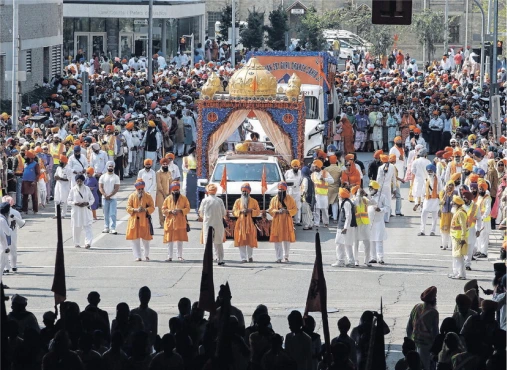
Members of the Manitoba Sikh community celebrate at the Nagar Kirtan parade in downtown Winnipeg on Sunday, September 3, 2023. The number of Canadians who are Sikh, Muslim or Hindu has grown rapidly in the past decade.
JOHN WOODS / FREE PRESS FILES
Copyright (c)2026 Winnipeg Free Press, Edition 5/30/2026
John Longhurst, a journalist with the Winnipeg Free Press, has it absolutely right. Canadians should not be telling the Census of Canada which religion their parents assumed they belonged to.