
By Scott Douglas Jacobsen
How has Bill 21 reshaped the legal and public understanding of secularism, religious freedom, and state neutrality in Québec and Canada more broadly?
Québec’s Bill 21, also known as An Act respecting the laicity of the State, received assent and came into force on June 16, 2019. The key idea: the state of Québec is a lay state.
The principles of Bill 21 are equality for all, the separation of the state and religions, the state’s religious neutrality, and freedom of conscience and freedom of religion. In practice, certain public officials are prohibited from wearing religious symbols while performing their duties.
Religious symbols can include clothing, headwear, jewelry, or items reasonably understood as indicating a religious affiliation. These rules apply to judicial and quasi-judicial personnel, government lawyers and prosecutors, police, peace officers, principals of public schools, etc. Schedule II includes teachers. This was controversial.
People in covered positions on March 27, 2019, were exempt via a grandfather clause. Teachers could be exempt if they remain in the same function within the same school board.
Faces must be uncovered for covered personnel and, when necessary, for members of the public receiving services for identity verification or security. Exceptions exist for disability, health reasons, or job requirements.
No adaptation is permitted for workarounds except as stipulated in the Act itself. It uses the notwithstanding clause twice. The Act does not require Québec to remove existing religious heritage from buildings, place names, or institutional names.
The current challenge before the Supreme Court of Canada is English Montreal School Board et al. v. Attorney General of Québec et al. The docket shows filings in early March 2026, with the hearing scheduled for March 23–26, 2026.
Bill 21 is not symbolic secularism. It defines Québec as a lay state, as noted. The wearing of religious symbols is restricted for certain state employees while shielded by the notwithstanding clause. It is now awaiting final Supreme Court review.
—
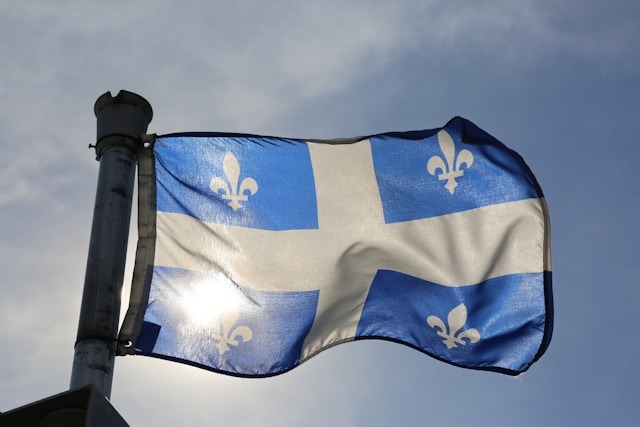
a flag on a pole, photo by Harry Spink, via Unsplash
Part of the trouble here is that the English media are calling B21 a “secularism law”, and likely this stems from the Quebec government itself, but *this is a mistranslation*. There is no easy way to translate “laique”, in the *political* into English – pragmatics of communication (‘the grab-bag field of linguistics’ as some somewhat unfairly call it) make this very hard.