Skip to content
Centre for Inquiry Canada (CFIC)

Centre for Inquiry Canada (CFIC)

Your humanist community for scientific, skeptical, secular, and rational inquiry.

  • About
    • What Is CFIC?
      • Mission, Vision, & Values
      • Centre for Inquiry Globally
      • Why We Need CFIC
      • History
    • Areas of Focus
      • Secularism
      • Scientific Skepticism
      • Critical Thinking
      • Building Community
    • Our Structure
      • Governance of CFIC
      • CFIC Bylaws
      • Branches
    • Supporters of CFIC
    • Contact
    • Privacy Statement
  • Media
    • Critical Links Newsletter
    • Podcast for Inquiry (PFI)
    • Other Videos
    • Cost of Religion Report
    • Search Archives
  • Get Involved
    • Join Us
    • Calendar of Events
    • Find a Local Branch
      • Victoria
      • Regina
      • Saskatoon
      • Winnipeg
      • Ottawa
      • Toronto
      • Montreal
      • Halifax
      • Virtual Branch
    • Volunteer
    • Mailing List
  • Donate
    • Donate to CFIC
    • CanadaHelps
    • PayPal
    • Interac Transfer
  • Become a Member
  • Toggle search form

Bill 21 and the Constitutional Boundaries of State Laicity in Québec

Posted on March 28, 2026March 31, 2026 By Critical Links 1 Comment on Bill 21 and the Constitutional Boundaries of State Laicity in Québec

By Scott Douglas Jacobsen 

How has Bill 21 reshaped the legal and public understanding of secularism, religious freedom, and state neutrality in Québec and Canada more broadly?

Québec’s Bill 21, also known as An Act respecting the laicity of the State, received assent and came into force on June 16, 2019. The key idea: the state of Québec is a lay state.

The principles of Bill 21 are equality for all, the separation of the state and religions, the state’s religious neutrality, and freedom of conscience and freedom of religion. In practice, certain public officials are prohibited from wearing religious symbols while performing their duties.

Religious symbols can include clothing, headwear, jewelry, or items reasonably understood as indicating a religious affiliation. These rules apply to judicial and quasi-judicial personnel, government lawyers and prosecutors, police, peace officers, principals of public schools, etc. Schedule II includes teachers. This was controversial.

People in covered positions on March 27, 2019, were exempt via a grandfather clause. Teachers could be exempt if they remain in the same function within the same school board.

Faces must be uncovered for covered personnel and, when necessary, for members of the public receiving services for identity verification or security. Exceptions exist for disability, health reasons, or job requirements.

No adaptation is permitted for workarounds except as stipulated in the Act itself. It uses the notwithstanding clause twice. The Act does not require Québec to remove existing religious heritage from buildings, place names, or institutional names.

The current challenge before the Supreme Court of Canada is English Montreal School Board et al. v. Attorney General of Québec et al. The docket shows filings in early March 2026, with the hearing scheduled for March 23–26, 2026.

Bill 21 is not symbolic secularism. It defines Québec as a lay state, as noted. The wearing of religious symbols is restricted for certain state employees while shielded by the notwithstanding clause. It is now awaiting final Supreme Court review.

—

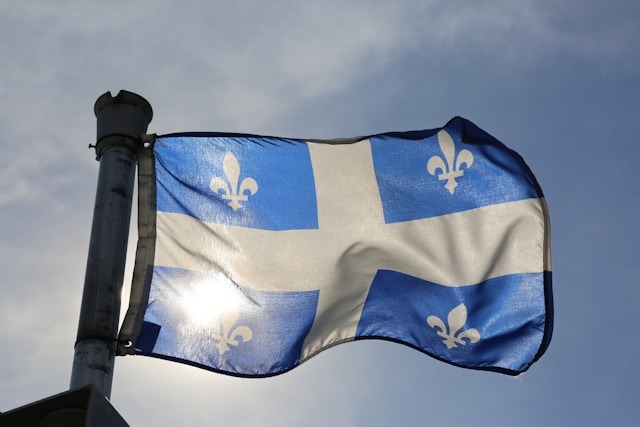
a flag on a pole, photo by Harry Spink, via Unsplash

Announcement, critical links, Secularism Tags:Atheism, critical links, human rights, Religion, Secularism

Post navigation

Previous Post: New Brunswick Mystery Brain Illness Investigation Finds No Evidence of a New Disease
Next Post: Outing Canada’s Ghost Religious Population

Comment (1) on “Bill 21 and the Constitutional Boundaries of State Laicity in Québec”

  1. Keith Douglas says:
    April 2, 2026 at 9:44 am

    Part of the trouble here is that the English media are calling B21 a “secularism law”, and likely this stems from the Quebec government itself, but *this is a mistranslation*. There is no easy way to translate “laique”, in the *political* into English – pragmatics of communication (‘the grab-bag field of linguistics’ as some somewhat unfairly call it) make this very hard.

    Reply

Leave a Reply Cancel reply

Your email address will not be published. Required fields are marked *

Donate via PayPal
Donate via Interac
Donate via CanadaHelps

Categories

a4a Amateur Science Announcement assistance for apostates Blasphemy Laws Blasphemy Laws CFI Community CFIC Volunteers Climate Change Cost of Religion critical links critical thinking Critical Thinking Week Debate Education Educational Material environment Event Give to CFIC governance health humanism Human Rights Information International Human Rights Living without Religion Media Advisory Medicine philosophy podcast Policy Press Release pseudoscience Quick Links quicklinks Science ScienceChek Science Literacy Secular Check Secularism Secularism in Schools Secular Rescue slider Think Check volunteer

View Full Calendar

Contact

Center for Inquiry Canada (CFIC) Logo

info@centreforinquiry.ca
613-663-8198
PO Box 83045, Ottawa RPO Bank Walkley, Ontario, K1V 1A3

CFI Canada is a CRA-Registered Educational Charity. Charitable Registration Number: 83364 2614 RR0001

Read our Privacy Statement.

Explore

Our Mission
History of CFIC
Latest Announcements
Podcast for Inquiry (PFI)
Donate to CFIC
Become a Member

Follow Us

Subscribe Now

Copyright © 2026 Centre for Inquiry Canada (CFIC).

Powered by PressBook WordPress theme