
Keith Douglas
Recap
Last time, I left the previous puzzle hunt’s solution unresolved. The trick (if it is one) to solving the puzzle is that one has to unshuffle the element symbols given the names (and only then read them as an acrostic). Otherwise, one will get Pingston, as hinted. (I did only go to the one here in Canada, though.) Potassium is abbreviated “K” – for “kalium”. So, you can then conclude that I went to (assuming, correctly, I did as planned) first to Kingston and then to Montreal. Technically, I also stayed in tungsten, europium, samarium, thallium, meitnerium, osmium, uranium, nihonium, terbium. (Same coding scheme!)
Steve W. responded to the questions about expertise. Taking each in turn, briefly.
- On 3: I agree there is non-propositional knowledge, and it seems that this is no obstacle to their being experts in these domains. It does not follow, of course, that all non-propositional knowledge is subject to expertise.
- On 5: This is a good point about logic – atomic propositions are indeed relative to an analysis, and it seems plausible that sometimes one needs subject matter expertise to do such an analysis. After all, it is trivial to make valid arguments to any conclusion in many formal systems: by simply restating a premise.
- About 6, he provides a suggestion about how to handle group expertise. I may pick up this one for another column! (We’ve already talked about social ontology a few times, after all.)
- In his discussion of 7 and 8, it is definitely true that there are two ways one can be an expert – I think this is maybe how S. Stroud’s remarks can be taken too. The limitation about wrongness in the approach in the light of the topic of theology is quite important. (Wittgenstein is famous for claiming that what we cannot go wrong about, we cannot go right about either. Is this so?)
Current subject
I’d like this time to address two “how do you know?” questions and a metaquestion about them.
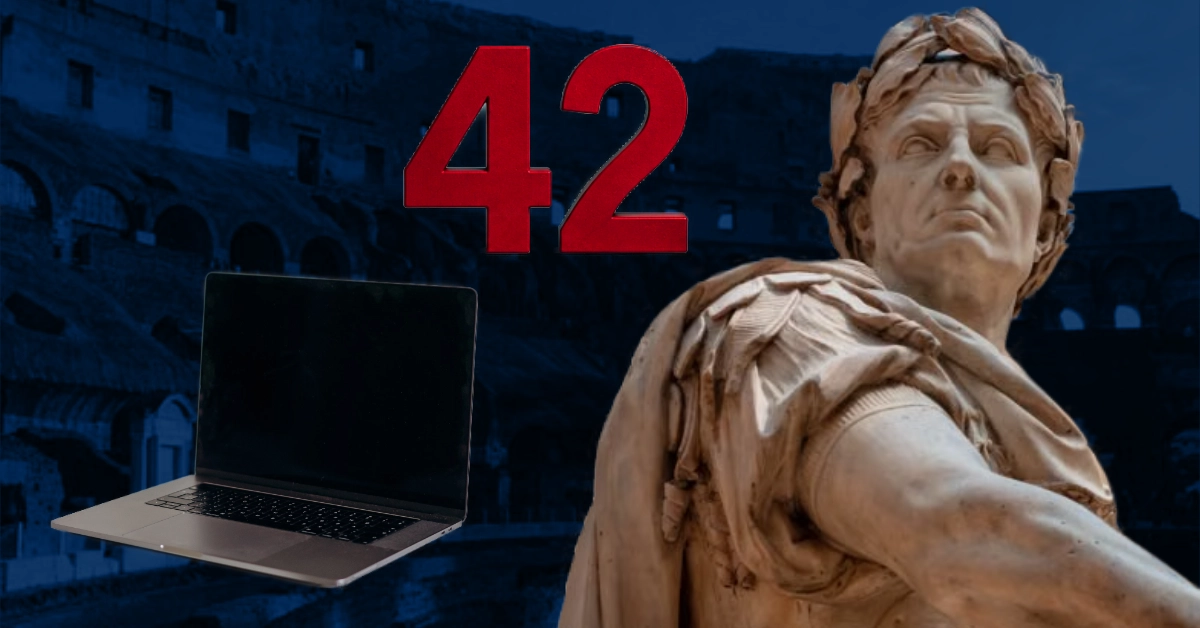
The first question long-time readers of the column will have seen already. This is the famous question of Frege, https://centreforinquiry.ca/keiths-conundrums-pseudo-wittgenstein-minipuzzles/, #15: how do we know that Julius Caesar is not a number?
The second is due to B. C. Smith, a philosopher of computing who is, to say the least, an eclectic and eccentric thinker – and one I did not encounter until doing informal work in the area as a hobby (like this column!). I regret never having had the chance to speak with him (as he says a lot of what I’d regard as off-the-wall, and yet also a lot of very useful but contentious things as well). In a biographical aspect of a “Five Questions” interview-essay, he repeats a question he apparently posed as an undergraduate: How do we know computing is a technology, and not an art?
I’ll address each of these very briefly (as usual, take them up yourself!) and then pose a metaquestion about these that I think is also worthy of reflection on.
To answer the first, I think one has to adopt one of a few more basic beliefs – if you don’t share these, we’ll come to that in the metaquestion. Julius Caesar is not a number because (1) he’s not the number zero or a successor to zero done by iteration of a set operation or whatever category theory “equivalent” you want. (2) He’s also not “constructible” by appropriate ordered pairs, so he’s not an integer or rational number, and then (3) not a real number because he is certainly not infinite in any relevant respect and (4) hence also not a complex number. And those are all the types of numbers that I know. (Should I include going through quaternions and octonions? 😊)
I think this argument sketch holds whether one is a Platonist like Frege or a fictionalist like me. If you hold another philosophy of mathematics, you can see if somehow the argument doesn’t cut it for your view. I would, however, suggest that if you cannot reliably show that Caesar is not a number from your philosophy of math, it is rather defective as a view. And this includes so-called metaphysics-free views, like structuralism. (That mathematical structuralism is not metaphysics-free we will discuss another time.)
Turning then to Smith’s question. This one is actually to my mind much harder. Since Smith offers the question in the context of biography, allow me to tell some of mine. Before my parents bought our first personal computer, we explored using one by (amongst other things) borrowing one a few times from the elementary school my sister and I attended (across the street from where we lived!). I somehow knew to ask the teacher helping us (our eventual grade 6 teacher, Mr. Niiya) to ask for a “special” disk to use beyond the Logo disks he had already included. He agreed, somehow, and I got to learning BASIC and Apple DOS. On the so-called “DOS 3.3 System Master” is a program, in BASIC, called “Brian’s Theme”. When I explored what this was and how it worked – despite having done “turtle graphics” in Logo – I had the reaction that this (the computer) was the most astonishing artistic medium ever devised. The “AppleVision” program also on the disk confirmed this – not just because both programs were visually (and in the latter case, audibly) stunning for me – but how they were written, how they could be changed, hidden (again in the case of AppleVision) and more.
I am not a very artistic person – I am musically incompetent (though I enjoy listening – I have a J-M Jarre playlist on now) and I draw (and enjoy drawing) the same way I did in grade 6, more or less (despite having done art classes since), for example. So, this reaction should be regarded by all – and it was by me – as itself astonishing.
So, this is all to say that I can understand Smith’s reaction – if indeed he has something like this in mind (it is a throwaway line and he’s dead now, so…). However, there’s a difference I should emphasize. My reaction as an elementary school student wasn’t that computing was art, but rather an artistic medium, which is something else. Something else could be the art even if computers are like a canvas or the air (what’s the medium for music?).
But returning more specifically – the only way I know to conclude computing is not an art is to use Louis Armstrong’s dictum about jazz for another purpose. And none of that takes away the aesthetic side of computing – from my early reaction to my aesthetics and human-computer interaction paper from my student days. The famous text Human Values and the Design of Computer Technology has a good title because it (implicitly), unlike some works which are ethical only, reminds us that there are more than ethical values at play in technology. So, I am left with a shrug.
I have to now confess that this shrug is why I am writing – the Frege case was a warm-up to show that baffling questions that seem to just make a mistake in presupposition or something like it, which I cannot begin to answer, do in fact come in degrees.
This leads me to my metaquestion of this column’s title: what is the obligation of the critical thinker who wants to be conversationally engaging, polite, etc. to do when confronted with a question that seems to assume in some way or other something utterly “out there”?
One analogy that comes to mind – which I think I have to reject but I am not clear why – is that these are the question versions of Chomsky’s famous “Colorless green ideas sleep furiously” sentence, which is syntactically standard English, but semantically anomalous.
I worry, however, that my judgement of rejection of this idea is coloured (!) by the seeming, possible, agreement I have with Smith on the aesthetics and the clear way to solve Frege’s problem (which is more or less Frege’s own, I might add).
I would, however, encourage one to try attacking the problem obliquely; that’s why I presumably was reminded of Chomsky’s sentence. After all, if Hofstadter is right and human cognition is analogical in profound ways, then … To put this in perspective, here’s what I take to be a question analogous to Chomsky’s sentence:
“What goes between the weather and the number three: a dream, Australia or blue?”
Here’s one I think that is a bit closer to our topic, though:
“How do we know that nothing is not a thing?”
This example is related to Carnap and Bunge’s criticism of Heidegger’s famous “Nothing nothings.” (I have tried to translate perspicuously here – it is hard. Bunge thought “Nothing noths” is better – I am not a native speaker of German like he was, so I’m not sure!)
I would answer this question by appealing to fiction, at first. Michael Ende’s famous The Neverending Story (exercise to the reader: is this the correct translation of the 4-way ambiguous German?) is called by some a Heideggerian fairy tale, and it therefore tries to discuss “the nothing”. The book makes it clear it interacts, etc. So, does that treat it as a thing? I have to say that my view on the matter is coloured by another experience – the 1980s movie of the story, since I saw that before reading the book. I introduce this because I can answer the question by pointing out that absences have no properties and hence no ability to engage in events (causally or otherwise). (I might add that this answer is unavailable for those that think that negative properties are legitimate. I cannot address in general why I hold that there are no negative properties in the current column)
I use this case as an example, because it returns to the “how do we know?” format, which I think also is a key – it requires metacognition to get the ball rolling. But I’m not sure how to take that further. So, I end with a reminder: “what do we know?” is a good “game” to play when problem solving (thanks, Mathnet!). In this case, that question has reminded me that I haven’t tackled the question directly epistemologically. But enough for now!
Hopefully this column has not just been amusing (I can hope) but also educational. If it has been either, however, it has served my purpose. See you next month!
¹ In fact, the same trick applies too – you’ll need to know that tungsten is named/symbolled “weirdly”.