By Onur Romano, Human Rights Chair and Director of Assistance for Apostates, Centre for Inquiry Canada
In 2015, a husband and wife in Tehran wrote a proposal for a documentary about the Islamic Republic’s cultural policies, from the 1979 revolution to the present day. They submitted it to the government, because in Iran you have to. It was rejected. Then, on 2 consecutive days, agents of the Islamic Revolutionary Guard Corps raided their home and their shop.
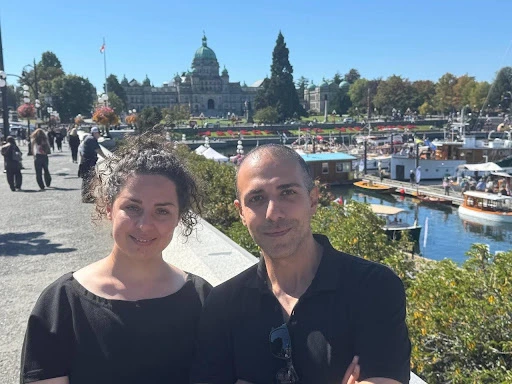
Their names are Ramin Saberi Jafari and Maryam Morovvati, who goes by Anahita. They are atheists. They are documentary filmmakers. And they are the first lives saved by Centre for Inquiry Canada’s Assistance for Apostates program. Over the next 6 months, I am going to tell you their story, one piece at a time, each piece complete in itself. This is the first: the story of the film.
What a film costs in Iran
Being an atheist in Iran is not a lifestyle. The Freedom of Thought Report records that identifying as non-religious is “illegal or unrecognised,” that apostasy is punishable by death, and that expressing a non-religious view is “highly likely to be met with hatred or violence.” Ramin had been an atheist since he was 18, after 2 years of reading his way through the history of religion. Anahita shared his views. Making a critical film about the regime, as 2 known non-believers, was not brave in the way a protest is brave. It was brave in the way walking into traffic is brave.
They did it anyway. After the raids they understood the interviews could not be filmed in Iran, so in 2017 they crossed into Türkiye to record them there. They packed for a shoot, not for a life. They expected to go home.
Within weeks, the colleague in Iran who had been coordinating their interviews with political activists was arrested by the IRGC. Agents raided the couple’s Tehran home again and confiscated everything connected to the film: footage, books, personal writings, the material that proved beyond any argument that Ramin was an atheist and both of them were enemies of the state. Going home now meant a prison cell at best. They walked into the UNHCR office in Ankara and asked for international protection.
Finishing it anyway
UNHCR sent them to Kütahya, a provincial city where almost no one spoke English, with no money, no housing and no legal right to work. Most people, in that position, would have put the film away. They had no equipment budget, no papers, no income beyond what 2 illegal workers could earn in workshops, and a regime that had already shown it was watching.
They finished it. Iranian Holocaust aired in December 2019 on Andisheh TV, a Persian-language satellite channel broadcasting from Los Angeles into Iran. Then they made another. Leaving the Land, about the asylum seekers stranded at the Türkiye–EU border in 2020, aired on Voice of America Persian. Two documentaries, made in exile, on no money, by 2 people the Iranian state was actively hunting.
I want you to understand what those broadcasts did. On the one hand, they made Ramin and Anahita more visible to the regime than they had ever been. The IRGC began threatening their family inside Iran. The couple’s fear became so acute that they made a desperate attempt to reach Greece and were caught at the border, which led to an order for their deportation to Iran, issued without a lawyer present. On the other hand, the films became the evidence. When Secular Rescue and ARAP later wrote to UNHCR on their behalf, the letters could point to a documentary on satellite television and confiscated writings in an IRGC evidence room and say, in plain language: these 2 people “would both be arrested and imprisoned immediately upon return to Iran.”
The thing that endangered them was also the thing that proved they were in danger. That is what it means to be an artist under a theocracy. Your work is both the crime and the alibi.
The cost, in full
The film cost them 9 years. Nine years in workshops, working illegally for wages that barely bought food, with no insurance and no protection. It cost Anahita a finger severed by a plate-making machine in a ceramics workshop, months of recovery before she could work again, and years of severe depression. It cost Ramin nearly 10 months confined at home with untreated bronchitis because they could not afford the treatment, and 2 jobs lost the moment an employer discovered he did not believe in God. It cost them a deportation order that was only reversed in 2021 because news outlets and social media abroad made noise about it. It cost them the country they were born in, which they will not see again.
And the film is also why they are alive and free. In July 2026, after a rigorous letter-writing campaign by ARAP and Secular Rescue, UNHCR resettled Ramin and Anahita in Canada. They landed in Vancouver with almost nothing. What they had was their names, their films, and the right to make the next one without asking a government’s permission.
Ramin wrote, a few weeks after arriving: “Today, we look toward a white, unwritten future. A future that has not yet been written, but that appears bright.” He is a filmmaker. He knows an unwritten script is not empty. It is a beginning.
Why I am telling you this
The phone call that changed their course came from a Persian-speaking case manager at the Atheist Refugee Assistance Program (ARAP) in Türkiye, a program I founded in 2020 through the Ateizm Derneği International Foundation here in British Columbia. I built it because I know this road: I am an atheist refugee myself. In 2014 I founded Ateizm Derneği (Association of Atheism) in Türkiye, the first and only legally recognized atheist human rights organization in the Muslim world. I know what it is to write 100 emails and get silence back. I built ARAP so that the 101st email would get a phone call.
This year CFIC joined the alliance of humanist refugee programs united under ARAP, alongside Minnesota Atheists and the David P. Silverman Charitable Fund, which single-handedly sponsors ARAP’s women’s shelter and refugee safehouse. Every Assistance for Apostates application is now vetted by Secular Rescue at the Center for Inquiry before A4A provides a service. Ramin and Anahita are the first result. There are more files on my desk. Some of them belong to people who also made something the state could not forgive, and who are, this morning, in a workshop in a Turkish city you have never heard of, waiting for a phone to ring.
The film cost Ramin and Anahita a country. It should not cost the next filmmaker their life.
How to help
Assistance for Apostates: The First Lives Saved, Centre for Inquiry Canada’s Assistance for Apostates fundraiser, runs until June 30, 2027 with a goal of $12,000. Every dollar goes to 3 things. $4,000: support of ARAP’s activities in Türkiye, which keeps its case managers, safehouse and legal aid running in Türkiye. Part goes directly to Ramin and Anahita as they rebuild their lives in Canada from nothing. The remainder goes to the next cases Assistance for Apostates and ARAP are working to relocate to Canada in 2027, people who are, right now, exactly where Ramin and Anahita were 2 years ago. Centre for Inquiry Canada issues tax receipts for all donations.
Give today: https://www.canadahelps.org/en/dn/149797