
This essay first appeared in Free Inquiry.
On June 16, 2019, Quebec passed Bill 21, Loi sur la laïcité de l’État or An Act respecting the laicity of the State, into law.
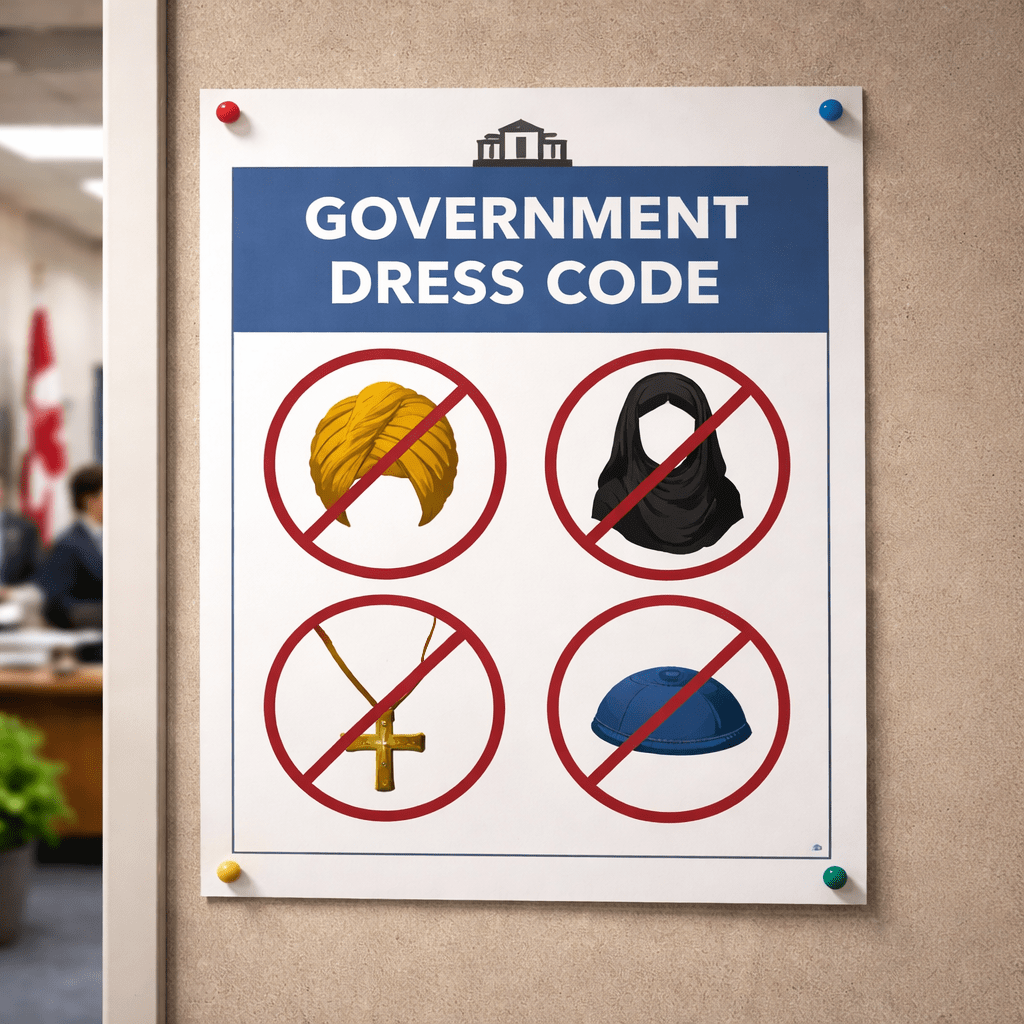
The controversial aspect of the bill bars many public-facing government employees, including judges, government lawyers, police, and teachers, from wearing ostentatious religious symbols. Doctors and nurses, also provincial employees, are not covered by the legislation.
- What is Secularism?
Political secularism is concerned with the government’s relationship with religion and how it treats the faith (or lack thereof) of its citizens. Bill 21 fails the secularism test no matter how it is defined.
Freedom of, and from, religion
Bill 21 infringes on freedom of religion by forbidding many government employees from wearing religious paraphernalia while they work. A provincial employee wearing a religious symbol does not imply that the provincial government endorses that faith – just as one cannot assume the editors of Free Inquiry agree with this article because they have published it. Absent a compelling argument that merely observing someone wearing a religious symbol is tantamount to religious coercion – and no such argument has been forthcoming – there is no countervailing violation of the secular principle of freedom from religion. Therefore, Bill 21 violates secular principles.
Separation of church and state
How can the government know if a man wears a bushy beard from aesthetic preference or religious observance? Is the state equipped to discern whether a woman wears a scarf on her head out of respect for her deity or a personal fashion sense?
Absent an individual proclaiming that a symbol is worn due to religious belief, it is impossible for the state to make any such determination.
When religion controls government, it is theocratic. When the government controls religion, it is authoritarian. Because Bill 21 puts the state in the role of determining, on behalf of the individual, whether a symbol is religious, the law intrinsically entwines church and state. It is therefore not secular legislation.
Government neutrality in matters of religion
The Centre for Inquiry Canada defines secularism as government neutrality in matters of religion. Put another way, the government should neither support nor suppress religious expression.
As the Supreme Court of Canada has noted, “state neutrality neither favours nor hinders any particular religious belief, that is, when it shows respect for all postures towards religion, including that of having no religious beliefs whatsoever”.
By barring provincial employees from wearing the clothing or accessories of their choice, Bill 21 suppresses religious expression. Thus, it violates the secular principle of government neutrality in matters of religion.
- Moral considerations
Canada’s constitution is the Charter of Rights and Freedoms, which defines the rights that Canadians enjoy. These rights are not absolute. Section 1 states that all Charter rights are “subject only to such reasonable limits prescribed by law as can be demonstrably justified in a free and democratic society.”
There is another way governments can exempt themselves from respecting Charter rights. Section 33 states that federal or provincial legislatures can declare an Act “shall operate notwithstanding a provision included in section 2 or sections 7 to 15 of this Charter.” This is known colloquially as the “notwithstanding” clause.
Supporters claim the restrictions Bill 21 places on provincial employees are reasonable. Yet if the Quebec government believed Bill 21’s provisions were defensible, it could have justified the law under Section 1. Quebec instead chose to invoke the notwithstanding clause to shield the legislation from judicial scrutiny.
While invoking the notwithstanding clause for Bill 21 might be a legally sound strategy, it is definitely a morally dubious approach.
- Practical considerations
Regulations that precede Bill 21 already forbade teachers from evangelizing their faith in the classroom.
In October 2024, several teachers were found to have created a toxic work environment at an elementary school in Bedford, Quebec. The local mosque carried a “strong influence” on several of the school’s staff members. The science, religion, and sex education curricula were not being followed. Female students were not permitted to play soccer.
When this came to light, there was an investigation, and 11 teachers were suspended.
We can draw three conclusions from this incident:
- A minority of teachers in Quebec are willing to give priority to their religious and cultural preferences and enforce them upon students in the classroom.
- No religious symbols are required for malign influences (including religious ones) to enter the classroom.
- There are effective mechanisms in place to discipline Quebec teachers who behave inappropriately without Bill 21.
What purpose does Bill 21 serve that is not already met?
- Tactical considerations
“Prohibition only drives drunkenness behind doors and into dark places, and does not cure it or even diminish it.” ~ Mark Twain
Forbidding a practice does little to change its prevalence – doing so only drives it underground. Sometimes, bans backfire and lead to an increase in the proscribed activity.
For example: when the United States Supreme Court overturned Roe v. Wade, abortions went up.
The purported harms that Bill 21 seeks to address – those inflicted upon members of the public who interact with a government lawyer, teacher, or public servant wearing a yarmulke, crucifix, hijab, or turban – are, at best, speculative. The harms of its implementation – the financial and social costs of removing many, especially female Muslim teachers, from their professions – are far more concrete.
Demanding government employees conform to a dress code that has no impact on their ability to perform their jobs is not the hallmark of a tolerant, secular society.
- Conclusion
There is no shortage of secular violations in Canadian society. The Charter “recognize[s] the supremacy of God”. The English version of the national anthem beseeches, “God keep our land glorious and free.” The French version contains even more overt religious symbolism. Three levels of government directly and indirectly subsidize religious institutions by over $5.5 billion every year. Ontario, Saskatchewan, and Alberta fund a Catholic school system, a benefit no other denomination enjoys.
Quebec’s Bill 21 violates secular principles, regardless of which definition of secularism is used. Any attempt to ban religious imagery requires the state to make a determination as to what is religious – something it is incompetent to do. The law serves no clear secular purpose, could have the opposite of its intended effect, and may cause significant harm while doing so.
“Bill 21 fails the secularism test no matter how it is defined.” Absolutely. In fact, some argue that it is disguised (sic) islamophobia, intended to play on the covert fears of the xenophobic voters outside of Montreal.
Bien sûr, les vrais croyants convaincus peuvent enlever leurs signes religieux et continuer à faire du prosélytisme au travail. Je suis étonnée que vous n’ayez pas compris ça.