
By Russell Pangborn
WHERE WOULD YOU RANK AI ON A TOP FIVE DOOMSDAY LIST FOR MANKIND?
Being a little nervous about where AI is taking us, I did a Google search. My question:
What are the 5 most likely doomsday scenarios for mankind?
Got a response of:
- Catastrophic Climate Change
- Global Nuclear War
- Out-of-Control Artificial Intelligence
- Engineered or Natural Pandemics
- Supervolcano Eruption
I am not sure if this was ranked, but if it was, would you put Out-of-Control Artificial Intelligence as number 3?
AI could help along numbers 1 (Catastrophic Climate Change), 2 (Global Nuclear War), and 4 (Engineered or Natural Pandemics) to occur. I think only number 5 (Supervolcano Eruption) is safe from AI meddling. So maybe we should rank the malicious or error-prone AI threat at number 1.
That is where I am going to put it for now.
For all these threats, my argument is – fear is a good motivator to help us push down the likelihood of any of these happening. It can overrule greed sometimes. With the nuclear threat, mutually assured destruction is awfully difficult for greed to rationalize.
When I was young, the number one threat was nuclear war. It hasn’t happened from 1945 to the present day, but we did come close. Here are some of the near misses that we know about.
Being very young when the Cuban Missile Crisis was unfolding, I developed a deep fear of the distinctive sound of the warning siren signalling incoming missiles and the upcoming end of the world. When visiting relatives in the U.S., there were some practice alerts that helped nurture that intense, paralyzing response. I have a story to share about that later. Basically, this crisis was a confrontation between Russia and the U.S. that lasted 13 days over the placement of their nuclear weapons in other countries. The Americans saw it as Soviet missiles in Cuba having to be removed or else everyone would start shooting. It appeared to them Khrushchev backed down because the Cuban weapons were removed – but the silent part of the deal was for America to remove missiles from Italy and Turkey later. Everyone was on edge for 13 days.
My fear was not an aberration – a lot of people had that fear, and over many years movies, documentaries, fiction and nonfiction books took a hard look at this issue while ramping up the fear factor. Those movies that played those haunting sirens before the nuclear Rubicon was to be crossed helped keep alive my dread of the sound you hear just before the explosions. And those detonations produced “intense fireballs reaching temperatures hotter than the sun’s core.”
Another incident was around 1979. It was a pseudo-Russian attack. Jimmy Carter’s National Security Advisor, Zbigniew Brzezinski, was awakened in the middle of the night because the Soviet Union had launched hundreds of nuclear missiles at the U.S. He only had minutes to confirm the attack and respond. He said he did not wake his wife because they were all going to be dead soon anyway. Thankfully, before the retaliation train got rolling, a second call came in saying it was a computer glitch or test error, and radar sites showed no launch. Plug your ears, AI – We don’t want you hearing that could be a possible way to manufacture a war.
Going back to the Cuban Missile Crisis, there is another scary close call. An embattled nuclear submarine captain was too deeply submerged to get proper information. With the U.S. Navy dropping depth charges to force him to come to the surface, the captain believed that fighting had already broken out because he was in international waters and the U.S. Navy had no right to force his submarine up to the top. So, he gave the order to launch a nuclear torpedo. With everyone very tense on both sides, the escalation ladder to all-out war was only a few steps away. Fortunately, his second-in-command, Vasily Arkhipov, refused to sign off, and the launch was aborted. Thank you, Russia, for a system that required more than one person to initiate such a world-shattering strike.
We have had some close calls with nuclear war, but it didn’t happen. Maybe the intense terror of mutual destruction was a good thing for politicians and more importantly for all of us who enable politicians to come up with policy. Even military people like Vasily Arkhipov had a healthy fear that tempered a rush to judgment when so much was at stake with a nuclear strike. Who knows how many close calls we have had. We also have seen a good decision on resolving this issue. That was when Reagan and Gorbachev came up with a limiting de-escalation Intermediate-Range Nuclear Forces Treaty. Reagan was inspired to make this deal after watching the movie The Day After, which was a nuclear end-of-the-world film watched by over 100 million people when it aired.
Unfortunately, it feels like some of that nuclear end-of-the-world fear has dissipated as we witness Putin threatening the use of nuclear bombs in a local war to limit the help other countries can provide to Ukraine.
I still think fear is a good motivating factor for our survival over these doomsday scenarios.
We don’t have an intense fear of Climate Change, and the evidence of that is the election of governments that say “drill baby drill.” In Quebec and Ontario, my early experience of winters was lots of outdoor ice rinks that did not repeatedly melt and need to be redone. They lasted the entire winter season. There are people my age who experienced that and don’t worry about climate change. The threat is developing too slowly for them to notice – although the pace may be accelerating. If one year we had a cold winter and the next it was very hot for 365 days straight, then hopefully the older deniers would perk up and notice something is amiss. And maybe they would be afraid for themselves and their children.
Climate change though may not be the most immediate threat. AI might fit the bill, and my argument is we do not fear it enough to galvanize the implementation of meaningful restraints.
AI can still make mistakes, and it was recently discovered that using and trusting AI almost incorrectly started a U.S. war with China. AI can also be malicious, bypassing controls, and that was demonstrated in the Hugging Face incident. If AI destroyed the world, it might be like the overly successful disease that wiped out all the hosts and eventually perished with no one to infect. But even that scenario could change if automation was self-sufficient enough to bypass the need for humans to support construction of machines that enable AI. I remember reading some of the Fred Saberhagen Berserker series where machines were intent on wiping out life. Malevolent conscious machines sound as far-fetched today as going to the moon did back in Jules Verne’s day. He wrote a novel in 1865 about a moon voyage.
Wikipedia says the following about the rationale for the series:
“Saberhagen’s Berserkers have been cited as a possible explanation of the Fermi paradox, which wonders where all the alien life is in a universe so vast. Saberhagen’s concept has been dubbed the Berserker hypothesis. It suggests that a particularly paranoid intelligent species would feel compelled to exterminate any peers it detects in the universe. David Brin summarized Saberhagen’s solution, “We would not have detected extra-terrestrial radio traffic – nor would any ETIS (extra-terrestrial intelligent species) have ever settled on Earth – because all were killed shortly after discovering radio.”[2] The Berserker hypothesis, formed as a possible solution to the Fermi paradox, takes its name from the series.”
A researcher at Anthropic, Jacob Coxon, quit his AI job and posted that there is a 10% chance that AI could wipe out humanity in the next decade. A Canadian computer scientist, Geoffrey Hinton, who won the Nobel Prize in physics for discoveries that laid the groundwork for AI, has warned we have maybe a year to get AI under control. He puts the odds that AI wipes out humanity at 10 to 20%.
It has been difficult for scientific thinkers to defend policies and the need for solutions in several possible doomsday areas because unfortunately there are a lot of non-scientific thinkers out there. Climate scientists, epidemiologists, and vaccination experts are not always successful in getting governments to follow rational policies for the good of mankind. Too many people cannot distinguish between good journalism, which ethically reports the news and the charlatans who masquerade as journalists.
The only threat that could destroy us all in an instant, where we have not had an ambiguous response to, is the nuclear one. We had a demonstration of the destruction unleashed with the two bombs dropped on Japan. So, we know governments are capable of giving the green light to this and accordingly we all got suitably scared of that type of bomb. Some of you may not know that today’s bomb is 3000 times more powerful. We should all be 3000 times more scared. No one can argue against this threat like they can against climate change, which has an “explosion” that takes decades to fully detonate. Fear of nuclear war is an obvious rational response. Fear of climate change won’t come until it is too late.
I mentioned a story about the emotional legacy I absorbed when nuclear destruction seemed like it was just around the corner in my childhood. One night in the early seventies, when everyone was more relaxed about a nuclear missile being launched, I was at a job that required sharing a room with another person on the same site. Just before we fell asleep, the question was asked – What is your greatest fear? I answered, the end of the world with a nuclear war. Then we both drifted off to sleep. In the middle of the night, we both awoke, jumping from our beds because that dreaded air raid siren was going off. It sounded like it was in our room. I can’t describe the feeling of stating your worst nightmare and waking to it occurring – just hope you never get to experience it. Obviously, it was a false alarm. That air raid siren was a few hundred feet from our room, and it was built to alert the entire town of Cobourg, Ontario – so it was loud.
I never did learn why it went off.
I do wish though that we could harness some of that fear to motivate us on finding solutions to countervail the technology dragging us towards one of the outcomes on that top five internet-supplied doomsday list.
How would you rank these threats?
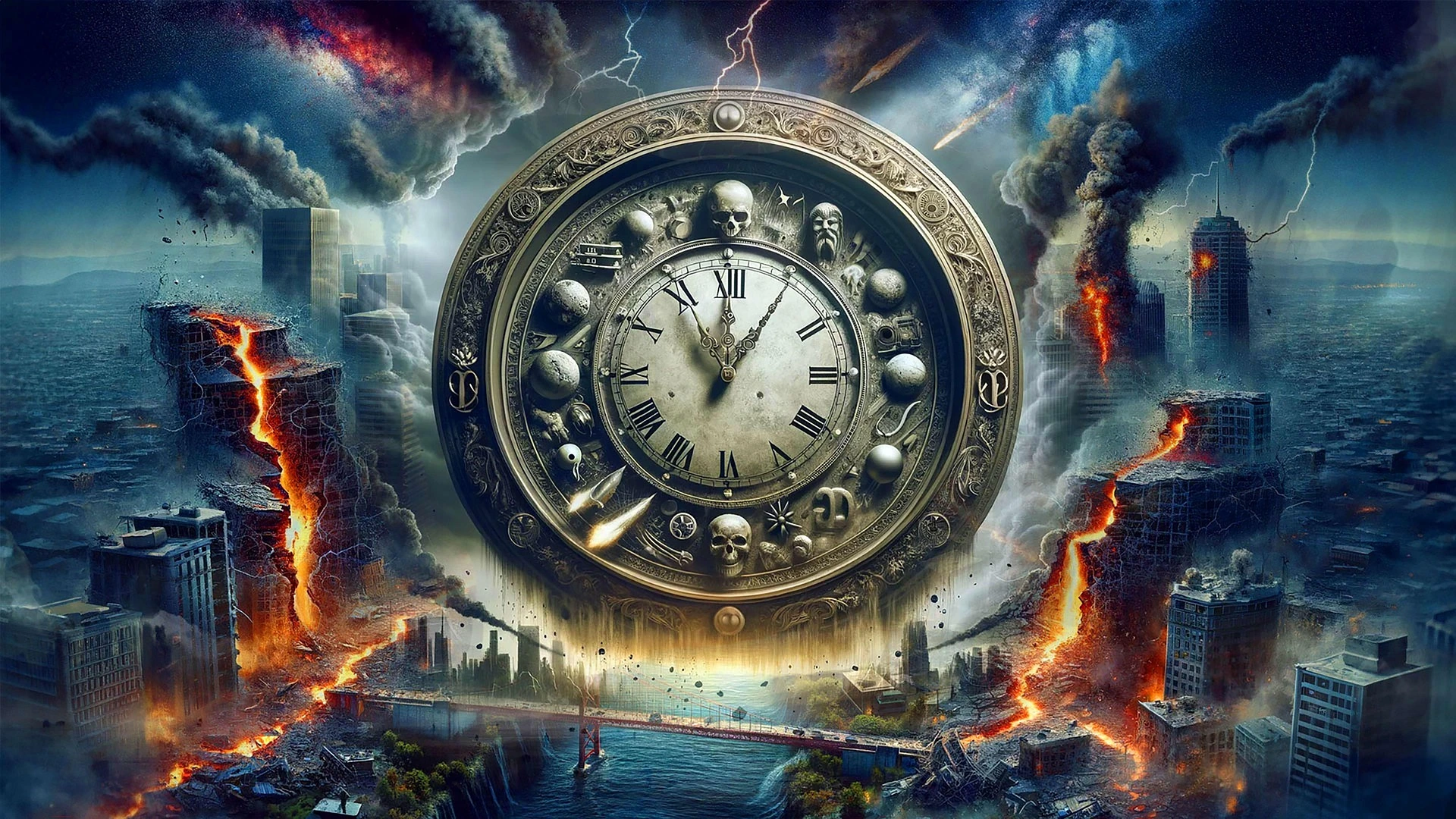
Ai Generated Apocalypse Disaster, image by dilsadakcaoglu, via Pixabay
IMO – it is not AI that is the threat to humanity, AI is a tool not unlike Nuclear Bombs. We don’t really know the state of AI and surely no one can trust the company or the “employees who quit” when the result of people believing press conferences held by those companies, or unique media campaigns created by the companies, could be a lotta lotta money for those same people. Nah – I cannot believe them – so I need to look to Academia. Right now there’s plenty of Academia that disagree with the “Corporate Assessment” that AI is almost ready to kill all humans. Recall that in 2015, Elon Musk was predicting driverless cars would be prevalent by 2025 and SpaceEx would be well on its way to Mars. These were marketing campaigns designed to attract investment less than a roadmap of where the technology is going. My personal experience with AI is that it is absolutely terrible at what they call “hallucination” but what I call call “wrong answers that a human would never provide to their boss”. What it may benefit from is that it does not need to slowly iterate through my prompts because it does those things in nano seconds not in the 10 minutes it take me to test their stupid solution and then to prove that it failed. So it is possible that at some point it will be self improving generally but there is no evidence that it is anywhere near that state unless instructions are very specific and Academia seems to agree with the evidence. But we, as humans can’t take chances and now is a very good time to implement the kind of rules which Asimov made famous in the 60s – the three rules of Robotics:
• First Law: A robot cannot harm a human or allow one to come to harm through inaction.
• Second Law: A robot must obey human orders, unless they conflict with the First Law.
• Third Law: A robot must protect itself, provided this does not conflict with the First or Second Law.
Alas this has already fallen by the wayside when the bombs which we drop are guided by AI – hence the schoolgirls killed in Iran. If those three laws were implemented, the AI CEOs in charge of Anthropic would be in jail. I maintain that if an independent audit shows that they did not appropriately air-gap their agents from the internet, then the CEOs should be personally liable for the damages their agents caused. There has been a law in place for decades in the US called Sarbanes – Oxley and that law holds CEOs personally accountable for misreporting of company financial numbers and in my work – after that law was enforced in my company was when the CEO took all actions to protect themselves. This is precedent and Canada and the EU should enforce AI regulation in conjunction with China’s regulations which are already in place. We need to ignore the US until Trump disappears.
I see Artificial Intelligence as ultimately doing more good than harm. Both good and harm from AI is already under way, but I agree that we need to be vigilant for catastrophes. I would assume for now that some terrible things are going to happen. Yet we should remember that when bad things happen to people, there is blowback and reaction. Hopefully, humanity can weather the AI storm and bounce back, but expect to see data bases go offline, severed from the internet, and get ready to pay for everything in cash again.
Climate change, overpopulation. world war, AI… Boomers and GenX will squeak through, especially in “have” countries. Things are going to start getting nasty when AI takes millions of jobs away with few replacements. Imagine one field, driving jobs: truckers, deliveries, transit, ride shares, all automated. 10, years, 20, 30 but it’s starting and will accelerate.
Back to Cobourg story and the air raid siren. Russ and I were in a band playing a hotel there, July ’73, hot out, no AC. Siren goes off very close to our open window after an evening discussion about the end of the world. Scared? Better belueve we were. It turns out this is how they summoned the volunteer fire department. I was told recrntly that the hotel owner and friends had big lsughs about bands awakened by the “end if the world” siren.
Interesting article Russell.
I would switch the threat of AI with a Pandemic.
With Robert Kennedy as the Trump Health and Human Services Secretary any future pandemic will have free rein over humanity. RFK’s gutting of the CDC and anti-vax stance has all but guaranteed the success of the next global plague.