

- This event has passed.
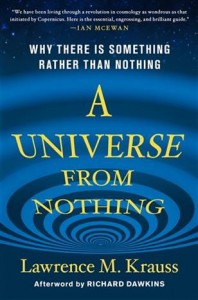
CFI Toronto – Science & Philosophy Book Club – “A Universe from Nothing” by Lawrence M. Krauss
 This group is hosted by CFI Canada members Christine Gagnon and Vlad Bunea at our National Headquarters, 55 Eglinton Ave E., Suite 307, Buzzer Code 49, from 7:00pm to 9:00pm. Suggested donation is $5. There is an after-event at a location near the office.
The goal is to provide a friendly, free-thinking environment in which to discuss books that inspire rewarding conversation on subjects related to science and philosophy.
This month we look at Lawrence Krauss’ book that tries to offer a paradigm-shifting view of how everything that exists came to be in the first place.
“Where did the universe come from? What was there before it? What will the future bring? And finally, why is there something rather than nothing?”
Reviews were mixed. Philosopher of science and physicist David Albert, in a review for The New York Times, said the book failed to live up to its title, and he criticized Krauss for dismissing concerns about his use of the term nothing to refer to a quantum vacuum instead of a “philosopher’s or theologian’s idealized ‘nothing'” (i.e. instead of having the meaning “not anything”).[5]
Commenting on the philosophical debate sparked by (and largely ignored in) the book, physicist Sean M. Carroll asks “Do advances in modern physics and cosmology help us address these underlying questions, of why there is something called the universe at all, and why there are things called “the laws of physics,” and why those laws seem to take the form of quantum mechanics, and why some particular wave function is Hamiltonian? In a word: no. I don’t see how they could.”
Physicist George F. R. Ellis, who is an active Quaker and winner of the infamous Templeton Prize (awarded to a living person who, in the estimation of the judges, “has made an exceptional contribution to affirming life’s spiritual dimension,”) when asked whether Krauss has “solved the mystery of why there is something rather than nothing,” notes that the “belief that all of reality can be fully comprehended in terms of physics and the equations of physics is a fantasy . . . Krauss does not address why the laws of physics exist, why they have the form they have, or in what kind of manifestation they existed before the universe existed (which he must believe if he believes they brought the universe into existence).”